Home Headlines Michael Eric Dyson’s Powerful Prayer Ignites Urgent Debate on Faith, Justice, Racism, Gun Violence and Political Hypocrisy
Michael Eric Dyson’s Powerful Prayer Ignites Urgent Debate on Faith, Justice, Racism, Gun Violence and Political Hypocrisy
0

Edrea Davis – The exchange between Michael Eric Dyson and Roland Martin carries the unmistakable weight of a moment that, in their view, could no longer be approached with politeness or restraint. What unfolded was not simply a controversial prayer, but a necessary interruption, a moment that demanded honesty over comfort.

Dyson’s prayer itself is not a ceremonial or neutral invocation. It is deliberately confrontational, framing the current political moment as “an extraordinary battle for the soul of America” and calling out what he sees as hypocrisy in the nation’s moral and political life. But more than that, it feels like a warning, a refusal to let the moment pass without naming what is at stake. He weaves together themes of gun violence, systemic inequality, attacks on constitutional principles, and the erasure of history, drawing a straight line between public policy and moral consequence. He speaks of a nation that claims freedom while restricting it, that praises democracy while undermining it, and that invokes faith while tolerating injustice.

He goes further, grounding that critique in specific moral contradictions. Referencing the anniversary of a school shooting while condemning a culture that “still worships guns,” he exposes what he sees as a disconnect between grief and action. He challenges selective reverence for the Constitution and the First Amendment, arguing that both are too often defended only when convenient. He calls out efforts to erase or sanitize history, particularly the central role of slavery, and denounces the banning of books that tell uncomfortable truths. He directly names what he describes as the corrosive influence of white Christian nationalism and a political culture fueled by deception, inequality, and the targeting of marginalized communities. In doing so, the prayer becomes a layered indictment, one that moves from national ideals to lived realities without softening its conclusions .

His language is vivid and urgent because, as he presents it, urgency is exactly what this moment requires. He condemns white Christian nationalism not as an abstract idea, but as a present force shaping policy and culture. He calls out political leadership he characterizes as dishonest and authoritarian, not to provoke, but to expose what he sees as a dangerous normalization of deception and abuse of power. He defends marginalized communities, naming Black people, immigrants, women, and others, as those bearing the brunt of these contradictions. In doing so, the prayer becomes less about ritual and more about reckoning, less about tradition and more about truth.

And that is precisely why the message carries such weight. Dyson’s prayer suggests that silence, or even softness, in a moment like this would amount to complicity. The directness is not incidental, it is essential. It reflects an understanding that the moral crises he describes, from violence to inequality to the distortion of both history and faith, cannot be addressed with vague language or polite abstractions. They must be named clearly, even if that clarity unsettles those in power. More than a critique, it is a call to listen, to confront, and to reckon with truths that are too often avoided.

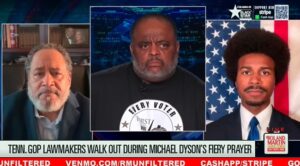
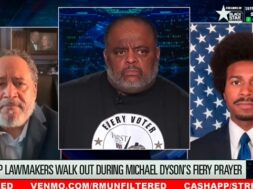
That urgency carries directly into the conversation with Martin. Martin leans into that framing, reinforcing the idea that the discomfort surrounding the prayer reveals more about its critics than about Dyson himself. The conversation draws a sharp distinction between a faith that is lived through justice and one that is used to justify power. Together, they suggest that what unsettled some lawmakers was not the presence of religion in the chamber, but the presence of a version of Christianity that refuses to ignore oppression. In the Black prophetic tradition, prayer is not meant to comfort the comfortable, but to challenge them. It is meant to confront hypocrisy, expose racism, and call out what Dyson describes as ungodly behavior wherever it appears, especially in places of authority.

Justin Pearson underscores that point by situating the prayer within a broader context. Legislative prayers are routine, but this one stood apart because it refused to be passive and refused to separate spirituality from accountability. It demanded that those in power reckon with the consequences of their actions. The reaction, including lawmakers walking out, becomes part of the story itself, illustrating the very resistance to accountability that Dyson’s prayer sought to confront.

Taken together, the prayer and the conversation make a clear argument: this was not a moment for symbolic gestures or sanitized faith. It was a moment that required clarity, courage, and conviction. Dyson’s words land with force because they are meant to. They reflect a belief that the country is at a crossroads, and that hearing, truly hearing, this kind of message is not optional, but necessary.