Underfunded and Overburdened: New Georgia Coalition for the People’s Agenda Report Warns Election System Is Reaching a Breaking Point






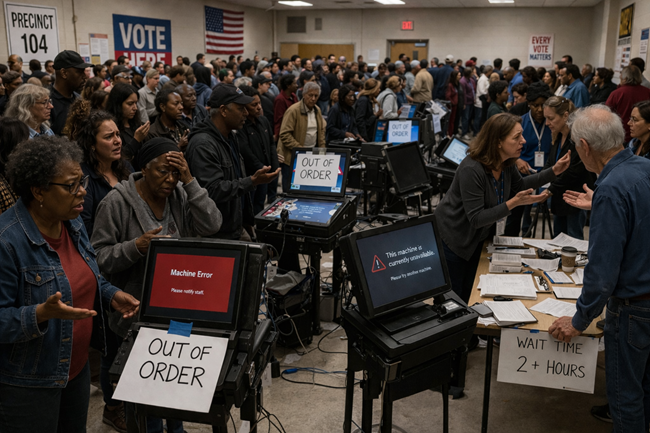
By Edrea Davis — A new five-part report series recently released by the Southern Poverty Law Center (SPLC), in partnership with the Georgia Coalition for the People’s Agenda, is sounding the alarm on what advocates describe as one of the most overlooked threats to democracy in Georgia: the chronic underfunding of elections and its growing impact on voter confidence.
Helen Butler, executive director of the Georgia Coalition for the People’s Agenda, said the findings should serve as a call to action for policym0akers 0at both the state and federal levels.
“Georgia’s election officials are doing everything they can with the resources they have, but the system is being pushed to its limits,” Butler said. “If we are serious about protecting democracy, we must invest in the infrastructure that makes free and fair elections possible. That means stable funding, thoughtful legislation, and real support for the people on the ground who make our elections work.”
The report series, titled Critically Strained: Underfunding in Georgia Elections, is based on two years of research, including interviews with election supervisors from rural and urban counties across the state. It documents how increasing legislative demands, paired with limited funding, are forcing counties to make difficult tradeoffs to remain compliant while still serving voters effectively.
According to the findings, counties continue to shoulder most election-related expenses—from maintaining voting systems to conducting voter outreach—often without sufficient state support. Even basic operational needs such as printers, batteries, and thermal paper remain underfunded in many jurisdictions.
The research also highlights the strain caused by a constantly shifting legislative landscape. Election officials report that new laws are frequently enacted without accompanying funding, creating budget uncertainty and administrative burdens that ripple across local election offices.
“For two years, we worked with counties and election officials in Georgia to gather data, accounts and interviews,” said Cindy Battles, policy director for the Georgia Coalition for the People’s Agenda. “We’re extremely grateful to those who work diligently to ensure voters have the best possible experience and that elections run efficiently and well. This has all culminated in a report that shows how important the election infrastructure is to our democracy. The recommendations in the report are the result of our research and the advice of election supervisors and will ensure safe, secure elections in which voters can easily cast their ballots.”
The consequences of underfunding extend beyond logistics. The report warns that poll worker recruitment and retention remain ongoing challenges, particularly as elections become more technologically complex. At the same time, election administrators are experiencing high levels of burnout, with turnover rates rising significantly in recent years.
Advocates say the findings have already driven meaningful policy impact. The SPLC and its partners successfully pushed for an additional $15 million in Georgia’s 2026 state budget to support election administration—funding aimed at easing administrative burdens, improving operations, and expanding voter access statewide.
“Securing $15 million for election administration in 2026 is a positive step forward,” said Isabel Otero, Georgia policy director for the SPLC. “However, Georgia still needs a sustained, long-term commitment to properly fund the systems, staffing, technology and upgrades required to keep our elections secure and running smoothly. The SPLC hopes the FY 2027 budget builds on this progress with additional investments, ensuring these ongoing costs are not shifted onto voters or already stretched local election offices.”
The report series outlines several key areas of concern, including the urgent need for funding to recruit and retain poll workers, maintain and upgrade voting equipment, and stabilize the election administration environment at the county level. It also offers 12 policy recommendations aimed at strengthening Georgia’s election infrastructure and ensuring long-term sustainability.
“Elections depend on trained staff, reliable equipment and strong local infrastructure,” said Thulasi Seshan, policy analyst for the SPLC. “This research shows that when election systems are underfunded, the entire democratic process is strained and vulnerable. Investing in election administration is not a partisan issue — it is a basic requirement for a functioning democracy. Georgia voters deserve better.”
Researchers emphasize that elections are designated as critical infrastructure at the federal level, underscoring their importance to national security and democratic stability. Yet without consistent and adequate funding, the report warns, the strain on Georgia’s system will continue to grow.
The report ultimately calls on both state and federal leaders to make sustained investments in election administration, arguing that well-run elections are not optional but foundational to democracy itself. Without that commitment, advocates caution, both efficiency and voter confidence remain at risk.