The Real Cost of Political Ignorance in Black America: Roland Martin Schools Nick Cannon and Amber Rose on Politics, History, and Power







By Edrea Davis –  In an era where podcasts, short clips, and viral conversations shape public opinion and influence policy, a troubling reality is becoming impossible to ignore: too many voices are loud, but uninformed.
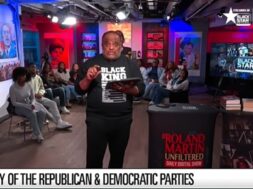
Following a widely criticized and historically inaccurate exchange between Nick Cannon and Amber Rose, journalist Roland Martin did not simply respond—he taught. What he delivered was not outrage, but a structured, fact-based correction rooted in history, policy, and consequence.
At the core of his message was a warning Black America cannot afford to ignore: We have too much to lose to be unserious about politics.
“Context matters,” Martin said as he dismantled oversimplified claims from Cannon and Rose, explaining that statements like “Democrats created the KKK” or “Republicans freed the slaves,” when stripped of context, become tools of manipulation rather than truth—pushing “HisStory” instead of history.
Martin makes the point that American racism has never belonged to just one party. It has been sustained across systems—Democratic and Republican—driven by power, policy, and what he described as a broader force of “whiteness.”
That clarity matters because misinformation is not just incorrect—it is dangerous. Whether it is intentional or rooted in ignorance, the outcome is the same: people are misled, narratives are distorted, and decisions are made on false premises that carry real-world consequences.
Martin’s reference to Ronald Reagan was a reminder that race in America has never been just a social issue. It has long been a political strategy.
He pointed to Reagan’s strong opposition to fair housing measures and his use of coded racial language—what many scholars identify as part of the broader “Southern Strategy,” designed to appeal to white voters’ anxieties without explicitly invoking race.
Reagan’s rhetoric around “states’ rights,” and the infamous “welfare queen” narrative were not accidental. They were strategic. They helped reshape public perception—casting Black Americans, and particularly Black women, as undeserving burdens rather than contributors.
Those narratives did not disappear. They evolved.
And today, they have been repackaged in new language—most notably through attacks on Diversity, Equity, and Inclusion (DEI) and Affirmative Action.
Black women, in particular, have become the symbolic targets—the face, or more accurately the scapegoat, of these policies. They are frequently portrayed as the primary beneficiaries of DEI and Affirmative Action, and by extension, as undeserving of their positions or opportunities.
But the data tells a different story.
White women have historically been the largest beneficiaries of Affirmative Action and related equity policies—particularly in employment, education, and government contracting. Yet in public discourse, White families are rarely positioned as the face of those programs.
Instead, Black women are made into avatars—visible enough to blame, but not statistically representative of who benefits most.
That distortion is not accidental.
It mirrors the same strategic framing used decades earlier—shifting attention and reshaping perception in ways that influence policy support.
So, while Black women are being publicly framed as beneficiaries of preferential treatment, they are simultaneously experiencing disproportionate economic vulnerability.
That disconnect is the result of narrative—not reality—underscoring Martin’s broader point: when people speak without knowledge, they are not just participating in conversation; they are reinforcing systems that have long worked against the very communities many of them rely on for a living.
“The real question is not where did the Republican Party stand in 1865… it’s where they stand in 2026,” he said.
Recent data shows how Republican policy decisions translate into real harm:
- Black women’s unemployment rose sharply in 2025, reaching as high as 7.3%, the highest in years
- The average unemployment rate climbed to 6.7%, significantly higher than the national average
- More than 300,000 Black women exited the labor force in just months, many tied to federal layoffs and cuts to public sector jobs
Martin’s frustration was not simply with celebrities—it was with the ecosystem that elevates entertainment over education.
Podcasters, influencers, and entertainers are not required to be historians. But when they step into political commentary, the responsibility changes—because audiences do not always distinguish between entertainment and fact.
And that confusion has consequences. When misinformation and disinformation spread:
• Voters make decisions based on false or misleading information
• Policies that harm communities gain support
• Hard-fought rights become easier to roll back
• History becomes distorted
There is also a deeper danger in the current push to sanitize or erase Black history. It is not simply about discomfort—it is about control.
When history is distorted or erased, it creates space for propaganda to take hold. It allows false narratives to replace documented truth. And it makes it easier for a new generation to accept policies and leadership that undermine democracy—whether that means attacks on voting rights, reluctance to uphold landmark decisions like Brown v. Board of Education, or the normalization of political extremism.
This is not a casual political moment. Yet, some of the loudest voices shaping opinion are offering half-truths.
People from all races and backgrounds marched, were brutally beaten, hosed, jailed, and died for the rights Black Americans have today.To treat politics as entertainment is to disregard that sacrifice.
To speak without knowledge is to risk undoing it.
In closing, Martin noted that every election season brings a new wave of voices speaking loudly without understanding. But as he put it plainly, what we are not going to do is allow misinformation to go unchallenged. This moment demands that platforms be used not just to talk, but to teach.
Because in this moment, Black America cannot afford anything less.
Watch on YouTube: https://www.youtube.com/watch?v=Ks6s9eqJCmw.