National Urban League Sues Trump Administration as Civil Rights Rollbacks Raise Specter of Jim Crow Jr.






From fair lending and Black employment to education and voting rights, federal policy changes threaten decades of economic and political progress for minority communities.
By Edrea Davis – The National Urban League and the Massachusetts Association of Community Development Corporations have filed a federal lawsuit challenging the Trump administration’s rollback of longstanding fair lending protections, adding to growing concerns that a series of federal policy changes could reverse decades of progress in economic opportunity for Black Americans and other historically disadvantaged communities.
The lawsuit, filed October 29 in U.S. District Court in Massachusetts, challenges changes made by the Consumer Financial Protection Bureau (CFPB) to Regulation B, which implements the Equal Credit Opportunity Act of 1974. The law was designed to protect Americans from discrimination when applying for mortgages, business loans and other forms of credit.
“This administration has waged a war on pathways to social and economic opportunity for communities of color and other groups,” said Marc H. Morial, president and CEO of the National Urban League. “Regulation B historically has served as a tool for growth and equal access to credit. The administration is wrong to try to set us back 50 years, and we will fight to stop these changes.”
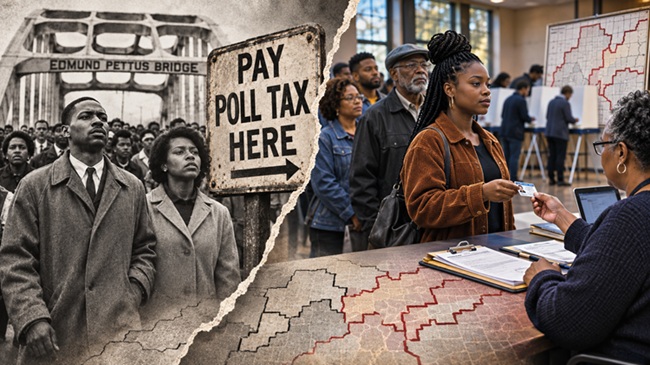
The sweeping changes have raised concerns among some people about a modern-day version of Jim Crow, an era when decades of progress toward racial equality were systematically dismantled. Following Reconstruction, Black Americans who had gained voting rights, political representation and greater economic opportunities saw those advances eroded through discriminatory laws, court decisions and the withdrawal of federal protections. Many of those laws appeared racially neutral on paper but were designed or enforced to discriminate against Black communities.
More than a century later, the Trump administration is challenging programs designed to address racial disparities, arguing that initiatives specifically benefiting minorities constitute discrimination. Yet critics point to a striking contradiction: While seeking to eliminate race-conscious programs intended to expand opportunity, the administration has supported voting district changes that a federal court found were driven by race and threatened minority political representation. From fair lending and federal employment to higher education and voting rights, the cumulative effects raise questions about whether the nation is witnessing the emergence of what critics might call “Jim Crow Jr.” — a new generation of policies that could reverse hard-won civil rights gains without explicitly restoring the discriminatory laws of the past.
The plaintiffs, represented by the Legal Defense Fund and the National Consumer Law Center, are asking the court to overturn three regulatory changes that they argue weaken protections against discriminatory lending practices and make it more difficult to challenge policies that disproportionately harm minority borrowers.
“The administration has argued that race-conscious lending programs and disparate-impact rules can encourage discriminatory treatment. Civil rights advocates counter that eliminating these protections makes it more difficult to identify discrimination and address longstanding racial inequalities in access to capital.”
Wells Fargo investigation raises additional concerns
The administration’s approach to fair lending has also drawn attention following an investigation into Wells Fargo over programs intended to increase Black homeownership.
In October, the Department of Housing and Urban Development announced an investigation into the bank’s initiatives to help Black Americans become homeowners, questioning whether the programs violate the Fair Housing Act. The matter is an administrative investigation, not a lawsuit.
HUD Secretary Scott Turner characterized the initiatives as potentially discriminatory, arguing that financial institutions should not make lending decisions based on race.
For civil rights advocates, the investigation highlights a fundamental disagreement over whether programs created to address historical discrimination should be treated as remedies for inequality or as forms of discrimination themselves.
Black federal workers disproportionately affected by job cuts
The administration’s efforts to shrink the federal workforce have also had an outsized impact on Black Americans, who have historically relied on government employment as an important pathway to middle-class stability, homeownership and retirement security.
A recent investigation by The Washington Post found that approximately 426,000 full-time federal workers departed government service during the first 18 months of Trump’s second term.
The newspaper’s analysis estimated that the number of Black federal employees declined by 30% following a surge in departures in September 2025, compared with a 4% decline among government workers of other races. The departures included firings, resignations and retirements.
The disproportionate loss of Black federal employment raises concerns about the long-term consequences for family income, retirement savings and generational wealth.
Recent economic indicators underscore the challenges facing Black families under this administration. According to the Bureau of Labor Statistics, Black unemployment increased from 6.2% in January 2025, when Trump took office, to 7.0% in September 2026, nearly twice the 3.6% unemployment rate for white Americans.
Colleges and minority-serving institutions face funding cuts
The administration has also targeted diversity initiatives at colleges and universities, challenging policies intended to increase educational access for underrepresented students.
In September 2025, the Department of Education announced the elimination of approximately $350 million in discretionary funding for minority-serving institutions, including colleges serving substantial Hispanic, Black, Asian American, Pacific Islander and Native American student populations.
The administration maintained that funding programs based on racial or ethnic enrollment thresholds were unconstitutional and should be redesigned to serve economically or academically disadvantaged students without racial classifications.
The cuts did not eliminate funding for Historically Black Colleges and Universities, which received a separate funding increase. However, other institutions serving large numbers of minority students faced the loss of resources supporting educational opportunity.
Voting rights protections face new challenges
The administration’s approach to voting rights raises further questions about its opposition to race-conscious policies. While challenging programs that specifically assist minorities as discriminatory, the Trump administration has supported redistricting efforts that civil rights advocates argue deliberately weaken minority voting power.
In Texas, President Trump pushed Republican lawmakers to redraw congressional districts to gain additional seats in the U.S. House. In July 2025, the Justice Department identified four districts with substantial Black and Hispanic populations as unconstitutional and urged state officials to redraw them. In November, a three-judge federal court found substantial evidence of racial gerrymandering, concluding that the Justice Department had encouraged Texas to redraw districts based on race. The Supreme Court subsequently stayed that ruling, allowing Texas to proceed with its new map while the litigation continued. Texas officials maintained that the redistricting was intended to achieve legitimate political objectives.
The administration has also shifted the Justice Department’s voting rights enforcement priorities, reversing positions in cases involving minority representation while pursuing voter registration and citizenship-verification requirements that civil rights advocates warn could disproportionately affect minority communities.
In April 2026, the Supreme Court further narrowed protections under the Voting Rights Act in Louisiana v. Callais, striking down a congressional district designed to provide Black voters with greater electoral representation. The ruling followed the Court’s 2013 decision in Shelby County v. Holder, which effectively ended federal preapproval requirements for election law changes in jurisdictions with histories of racial discrimination.
The developments echo a central lesson of the Jim Crow era: political disenfranchisement and economic inequality are closely connected. When minority communities lose political influence, they also risk losing the ability to shape decisions affecting education, employment, housing and economic opportunity.
A fight over the future of economic equality
At the center of the National Urban League’s legal challenge is whether the federal government will continue to permit targeted efforts to address documented racial disparities in lending and hold financial institutions accountable for practices that disproportionately exclude protected groups.
“Fair access to credit allows families to buy homes, entrepreneurs to start businesses, and communities to build wealth,” said Emily Haber, president and CEO of the Massachusetts Association of Community Development Corporations.
For Black Americans, the stakes extend beyond a single banking regulation. Employment, education, homeownership, access to capital and political representation have long been interconnected pathways to economic advancement. Weakening protections in any one of these areas can deepen disparities in others, threatening both economic opportunity and the political power needed to protect it.
The National Urban League and its legal partners maintain that dismantling fair lending protections at a time when Black borrowers already face significant obstacles threatens to widen the nation’s racial wealth gap.
Whether the courts uphold the CFPB’s changes could help determine how much authority federal regulators retain to address lending discrimination in the years ahead.