Melania Trump’s Epstein Statement Was a Major Communications Blunder That Undermined Her Credibility
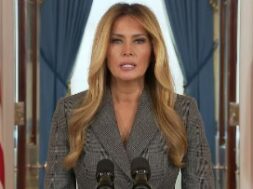






Edrea Davis – By any professional communications standard, credibility is never built in a single statement. It is built over time, through consistency, honesty, and alignment between words and reality. That is why the recent press statement from Melania Trump regarding the Jeffrey Epstein files lands as more than a misstep—it is a profound strategic miscalculation. It raises a deeper question about judgment, character, and public trust.
After more than a year of sustained public pressure to release information connected to Epstein, her decision to speak now feels less like leadership and more like image management. From a communications standpoint, it reads as an attempt at personal repositioning—one that ultimately undermines her credibility.
There appears to be an effort to separate herself from the controversies surrounding her husband, Donald Trump. That instinct is understandable. Public figures, especially spouses of political leaders, often attempt to carve out independent identities. However, separation is not achieved through denial when the public record tells a different story.
In communications, perception is reality—but perception must be grounded in plausibility. When a statement contradicts widely available images, documented associations, or prior interactions, it does not reset the narrative. It amplifies skepticism.
This is where the issue shifts from politics to character.
Supporters often deflect criticism by pointing to policy or partisanship. But for many people, this has never been about political ideology. It has always been about behavior.
Long before entering politics, Donald Trump publicly boasted about his sexual exploits. Those statements were not whispered accusations—they were part of his own narrative. That pattern continued over decades, culminating in the now well-known recording in which he described grabbing women without consent. He described walking up to women and grabbing them without consent, which reflects behavior that is both aggressive and illegal in the United States.
Beyond that, more than two dozen women have accused him of sexual misconduct. He was found liable for sexual assault in a civil case. There was also a lawsuit alleging rape involving a minor, later withdrawn, but still part of the public record that shapes perception. In interviews, he openly acknowledged knowing Epstein and commented that Epstein “liked them young.”
Taken together, these are not isolated incidents. They form a pattern—one that many people interpret as aggressive or predatory in nature.
That context matters.
When Melania Trump steps forward and asks the public, implicitly or explicitly, to separate her from that reality, she is asking them to overlook not just allegations—but a consistent public persona built over decades.
It is difficult for many to do that.
Comparisons to Bill Clinton and Hillary Clinton are often raised, but they ultimately highlight the difference. Bill Clinton’s misconduct, while widely condemned, involved consenting adults. Allegations beyond that were never proven in court. Bill Clinton also maintained a public persona widely viewed as charismatic and affable—very different from Donald Trump’s more combative style. For some, that allowed space—however uncomfortable—to understand Hillary Clinton’s decision to remain in the marriage.
The Trump situation does not offer that same clarity or comfort.
Melania Trump’s own public record does not help bridge that gap. From promoting the birther conspiracy about Barack Obama to the plagiarism controversy involving Michelle Obama, to launching an anti-cyberbullying initiative while never addressing the most visible example of such behavior in her own orbit—her husband—these moments have contributed to an image that feels selective rather than principled.
She also dismissed her husband’s recorded comments about assaulting women as “locker room talk.” That response alone raises a fundamental question: even if one were to dismiss the behavior itself, what does it say about judgment to excuse language that normalizes sexual assault?
Then comes the Epstein statement.
Denying familiarity with Ghislaine Maxwell and Epstein himself, despite photographic evidence and documented social overlap, strains credibility. In communications, when a statement contradicts what people can easily verify, it does not persuade—it alienates.
Equally important is what she chose not to address. There was no acknowledgment of her husband’s long-documented association with Epstein or the fact that he appears multiple times in Epstein-related documents. No attempt to reconcile that history. No recognition of the broader concerns people have about character, accountability, and pattern of behavior.
And that omission speaks volumes.
Because at its core, this is not about whether Melania Trump can build her own identity. It is about her own character.
Many women have stood by their partners through difficult and even embarrassing circumstances. That, in itself, is not what draws criticism. What makes this different is the nature, scale, and consistency of the behavior involved.
At a certain point, support begins to look less like loyalty and more like complicity.
So what was the objective?
If the goal of this statement was to reshape how people see her, it failed—not because people are unwilling to listen, but because the message did not align with what they already know.
In fact, by stepping forward only to deliver a statement that raised credibility concerns—and then declining to engage further—she forfeited one of the most valuable tools in modern communications: controlled transparency.
For years, Melania Trump maintained a degree of separation from her husband’s most controversial rhetoric by remaining largely silent. That silence allowed some members of the public to project neutrality—or even sympathy—onto her. This statement disrupts that dynamic. It replaces ambiguity with clarity.
Ultimately, this was more than a missed opportunity—it was a failure of strategy. By allowing this statement to move forward, the communications team reinforced existing doubts, invited new scrutiny, and erased any distinction from her husband that Melania Trump may have been trying to establish. In doing so, they did not protect her image—they confirmed, in real time, what had previously been a matter of speculation: that her judgment, character, and beliefs are aligned with her husband.
Whether this was a damaging mistake or an attempt to get ahead of news to come, the result is the same—her credibility is now in question.