BIPOC Climate Justice Summit Centers Community Power, Public Trust and Accountability as Supreme Court Considers Major Climate Case





NEW YORK — After the U.S. Supreme Court opened its new term with arguments in a major climate case that could shape the future of lawsuits seeking to hold fossil-fuel companies accountable for climate-related harms, HBCU Green Fund and ACE Observatory are spotlighting key issues raised during their 6th Annual BIPOC Climate Justice Summit: Climate Democracy Frontiers, held at the American Museum of Natural History during Climate Week NYC. The summit examined broader questions of building power, public trust, community responses to environmental challenges, funding and accountability.
“This summit provides a space where communities impacted by climate change can help define solutions and challenge systems that produce inequity,” said Felicia Davis, founder of the HBCU Green Fund. “The Supreme Court case now being considered is one example of why this work matters. Climate justice is about solutions and accountability, especially when fossil-fuel companies are accused of knowing the risks and misleading the public. Accountability is not hostility to business; it is part of the social contract.”
“We are confronting the climate crisis at a moment of declining public trust and rising threats to democracy. This Summit is a space built for us, by us, where frontline communities are not simply invited into the conversation, but shape the agenda,” said Dr. Isatis Cintrón-Rodríguez, climate scientist and director of ACE Observatory. “From Puerto Rico and the U.S. to Albania, Seychelles, the Marshall Islands and Samoa and beyond, we are building relationships across movements and borders, strengthening our collective power and showing what climate cooperation looks like when communities are recognized as leaders, knowledge holders and decision-makers.”
The program opened with an address by Chase Iron Eyes, an attorney, activist, and member of the Oglala Lakota Nation who was raised on the Standing Rock Indian Reservation. He declared, “African people have navigated this colony in explosive ways, and now we find ourselves in this situation where we have no other choice but solidarity if we want to survive.”
 During the panel Truth Is a Climate Issue: Defending Science, Information, and Democracy, Dr. Genevieve Guenther, author of The Language of Climate Politics, discussed how climate change is communicated through language, from media coverage to propaganda and disinformation. Jessica Cruz, deputy director of the New York City Mayor’s Office of Climate & Environmental Justice, shared how the city connects the climate crisis to everyday concerns such as housing, affordability and quality of life to help residents understand the relevance of climate justice.
The audience got a glimpse into history when biophysical chemist and American Museum of Natural History President, Dr. Sean M. Decatur, introduced members of the National Technical Association (NTA) for a panel marking the organization’s 100th anniversary. The discussion explored contributions of Black professionals in STEM over the past century and challenges that remain today, including misinformation, mistrust of science, the need to inspire more young people to pursue careers in science and technology.
Hattie Carwell, a physicist, presented a look back at the organization’s founders and past leaders, including Katherine Johnson, the trailblazing mathematician and NASA space scientist portrayed by Taraji P. Henson in the award-winning film Hidden Figures. Other NTA panelists included Kyesha Ruffin, founder of Science in the City; Dr. Ambrose Jearld, a marine biologist; Gary Harris, a nuclear engineer; and Dr. Shelia Stiles, a research geneticist.
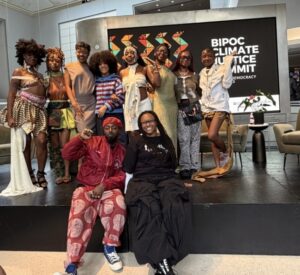 The Museum’s Hall of the Universe, displaying galaxies, stars, and planets, provided a cosmic background for the NTA and an innovative runway for the eco-fashion show featuring designs by Monsurat Amoo, a sustainable fashion designer and HBCU Green Fund Alumni Fellow. The audience also viewed short films about inner-city farmers produced by and featuring chef and eco-hip-hop artist DJ Cavem, who later took the stage for a live performance.
When Communities Lead, Democracy Works, led by Dr. Frances Gregory of the HBCU Green Fund, explored how residents and elected officials can work together to advance community-designed clean-energy solutions.
The Future Belongs to Us: Building the Next Frontier of the Global Climate Justice Movement closed the summit with a call for deeper collaboration, stronger frontline leadership, coordinated cross-border action and greater accountability for those responsible for climate harm. The panel featured Dr. Isatis M. Cintrón-Rodríguez; Ayisha Siddiqa, Planetary Guardians; Thalia Cachimuel, BLIS Collective; and Jacqueline Patterson, The Chisholm Legacy Project.
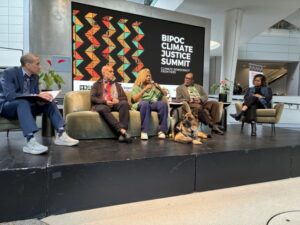
Additional panels included Systemic Approaches: Education That Builds Power, moderated by Dr. Willie Williams, Columbia Climate School, with Dr. Michel Gelobter, Yale Center for Environmental Justice; Kristina Douglass, Columbia Climate School; Dr. Myron Williams, Clark Atlanta University; and Sheila Foster, Columbia Climate School; Culture as Resistance: Art, Music & Climate Justice, moderated by Samira Siddique, Center for Earth Ethics; Defending Land: Frontline Communities Against Extraction and Climate Disaster, moderated by AJ Hudson, climate justice advocate; and Funding the Future: Reimagining Finance and Mutual Aid for Climate Justice, moderated by Dr. LaDawn Haglund, CUNY.
The 6th Annual BIPOC Climate Justice Summit was co-convened by HBCU Green Fund, ACE Observatory, the National Technical Association, Columbia Climate School and dozens of frontline organizations, in partnership with the American Museum of Natural History as host partner.
ABOUT HBCU GREEN FUND
Based in Atlanta, with offices in Washington, D.C., and Dakar, Senegal, the HBCU Green Fund works to transform historically Black colleges and universities (HBCUs) into models of sustainability, resiliency hubs and anchors for sustainable development. Through investments in HBCUs, students and surrounding communities, the organization advances environmental, social and economic justice while helping prepare the next generation of global green leaders.
ABOUT ACE OBSERVATORY
The ACE Observatory advances people-centered climate action by strengthening public participation, accountability and community leadership. Grounded in the United Nations Framework Convention on Climate Change’s Action for Climate Empowerment framework, it connects communities, civil society and government while promoting a just transition.
PHOTO CAPTIONS (FROM L-R):
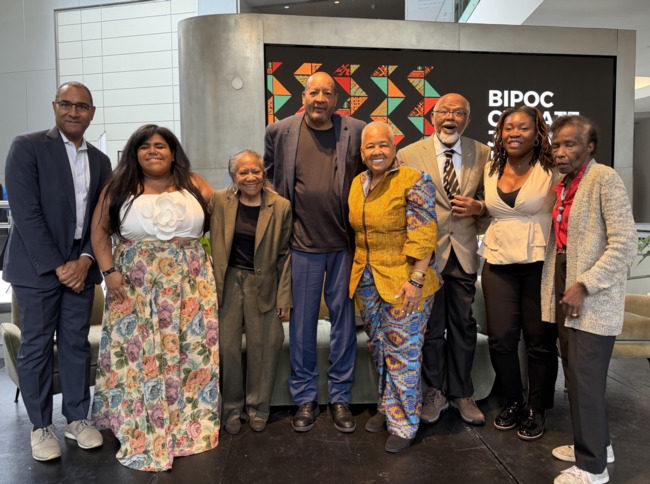
Photo 1: Dr. Sean M. Decatur, president of the American Museum of Natural History; Dr. Isatis Cintrón-Rodríguez, climate scientist; Dr. Shelia Stiles, research geneticist; Gary Harris, nuclear engineer; Felicia Davis,HBCU Green Fund; Dr. Ambrose Jearld, marine biologist; Kyesha Ruffin, Science in the City; and Hattie Carwell, physicist, following the National Technical Association centennial panel at the 6th Annual BIPOC Climate Justice Summit.
Photo 2: Dr. Michel Gelobter, Yale Center for Environmental Justice, speaks during Systemic Approaches: Education That Builds Power at the 6th Annual BIPOC Climate Justice Summit. From left are moderator Dr. Willie Williams, Columbia Climate School; Gelobter; Kristina Douglass, Columbia Climate School; Dr. Myron Williams, Clark Atlanta University; and Sheila Foster, Columbia Climate School. Douglass’s dog joined the panel onstage.
Photo 3: